Some years ago, a batch of microcontrollers arrived at an EMS facility in perfectly convincing factory packaging. The reels were sealed. The labels were right. The certificates of conformance traced back, on paper, to the original manufacturer. The parts passed a visual check and went onto boards. Six weeks later, units started failing in the field — and decapsulation told the real story: the dies inside were a different, older design, harvested from scrapped boards, re-marked, and dressed up as new.
Every quality manager in this industry has a version of that story, and the details keep getting worse. The counterfeit electronic components business has professionalized. The crude clones of twenty years ago — the misspelled logos, the sanded-off markings you could catch with a desk lamp — still exist, but they are the bottom of the market now. The top of the market produces fakes that are engineered to survive your incoming inspection.
This is a field guide to what is actually out there, and to the inspection methods that catch what your eyes and your paperwork can't.
The four species of counterfeit
Almost everything fake in the component supply chain belongs to one of four families, and knowing which family you're dealing with determines how you catch it.
Recycled and pulled parts are the most common by far. Genuine dies, harvested from scrapped circuit boards — often by crude heating that subjects them to thermal shock and electrostatic abuse — then cleaned, re-plated, and sold as new. They are real silicon, which is exactly what makes them dangerous: they can pass a basic functional test while carrying invisible damage that kills them months into the field. Electronics recycling streams, much of them flowing through informal workshops, feed this trade at industrial scale.
Remarked and blacktopped parts begin life as legitimate, cheaper components — a commercial-temperature-grade part re-marked as an industrial or military grade, a slower speed bin dressed as a faster one, an old date code resurfaced to look fresh. The tell used to be in the surface: blacktopping, where the package top is ground down and recoated, leaves texture and solvent clues. The better operations have gotten better at hiding them.
Cloned and overproduced parts come from the other direction: unauthorized production. A contracted factory runs an unrecorded night shift on the original tooling, or a clone house reverse-engineers the die outright. These are the rarest species and the hardest to discuss at dinner parties, but for commodity parts with huge volumes, the economics work.
Ghost parts are the crudest and, in a shortage, the most profitable: empty packages, dummy dies, or scrap chips in authentic-looking reels, sold into a panicked market that has stopped asking questions. When a part is allocated at fifty-two weeks and someone offers you fifty thousand pieces from stock, the ghost trade is who answers.
Why your paperwork stopped protecting you
Here is the uncomfortable development of the last two years, and it deserves plain statement: documentation is no longer evidence. Certificates of conformance, test reports, traceability letters — the entire paper shield buyers have relied on for decades can now be produced to a flawless standard by generative AI, in minutes, in any letterhead. A forged CoC that once betrayed itself with a typo or a wrong logo now arrives perfect. The counterfeiters' bottleneck was never the silicon; it was the paperwork. That bottleneck is gone.
This doesn't mean documentation is useless. It means its role has changed. Paper is now a cross-check, not a verdict: does the lot code format match the manufacturer's real convention for that year? Does the traceability chain survive a phone call to each link? Paper that is merely plausible proves nothing; paper that survives verification still means something. But the verdict now lives in the physical evidence, which is why the inspection bench matters more than it ever has.
What actually catches fakes
No single test catches everything, which is why serious inspection is a ladder — each rung catches what the one below misses.
It starts with external visual inspection under magnification: package texture, marking quality, laser-etch versus ink, pin condition, the telltale re-surfacing marks of blacktopping. This catches the careless fakes and flags the careful ones, but it cannot see inside the package.
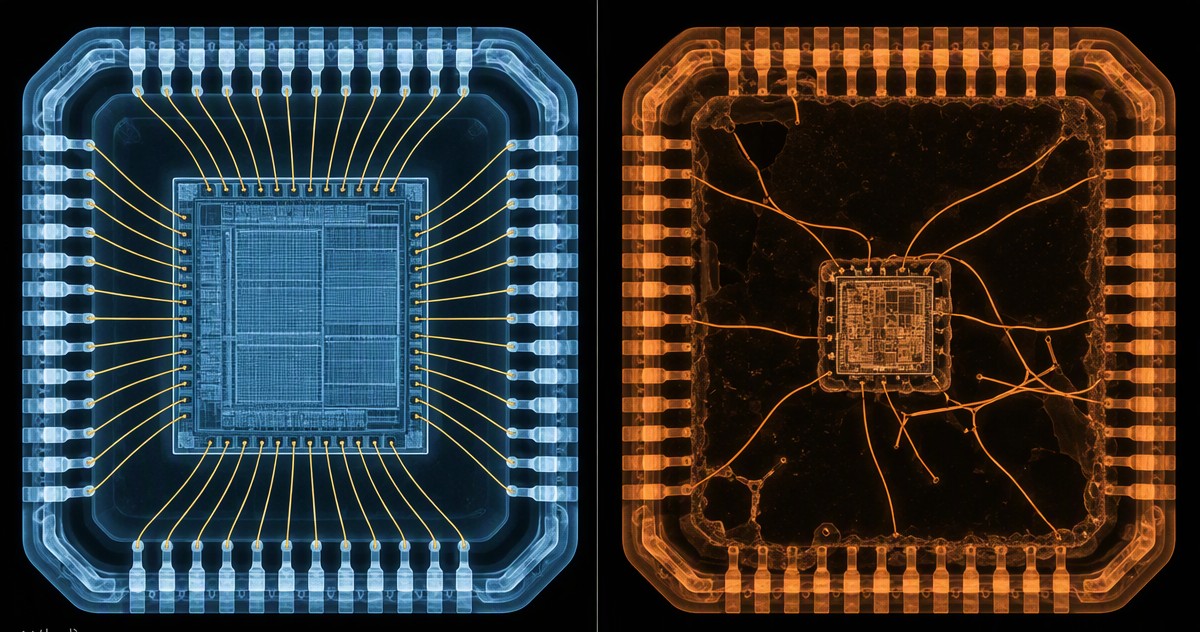
X-ray inspection can. The internal architecture of a genuine part — die size and position, bond wire pattern, lead frame geometry — is a fingerprint. A pulled part with broken or re-bonded wires, an empty package, or a die of the wrong dimensions shows itself immediately. This is the workhorse of counterfeit detection, fast and non-destructive.
XRF analysis reads the material composition of the package and leads. It catches lead-finish substitutions — the re-plating that recycled parts depend on — and RoHS anomalies that betray a different manufacturing origin than the label claims.
Solderability testing answers the question field failures ask later: will these leads actually wet properly? Years of improper storage and the chemical stripping used in recycling leave leads that look acceptable and solder badly. A sample from each lot tells you before your SMT line does.
And at the top of the ladder, for high-risk or high-value lots, decapsulation and die analysis: etch off the package, look at the die itself under a microscope, compare the die markings and layout against a known-genuine reference. This is the court of final appeal. It is also destructive, which is why it is used on samples, not whole lots — and why it must sit at the end of a risk-based process rather than the beginning of a reflex.
| Counterfeit species | What it is | What catches it |
|---|---|---|
| Recycled / pulled | Genuine dies harvested from scrap boards | X-ray (wire damage), solderability, surface microscopy |
| Remarked / blacktopped | Cheaper grade re-labelled as premium | Surface microscopy, solvent tests, XRF, decapsulation |
| Cloned / overproduced | Unauthorized production or reverse-engineered die | Decapsulation vs. known-good die, electrical characterization |
| Ghost | Empty package or dummy die | X-ray, basic electrical test |
The cheapest inspection happens before you buy
All of this said, the highest-leverage counterfeit defense isn't a machine; it's supplier selection, done before money moves. A supplier with a verifiable physical operation, years of traceable history, membership in industry bodies like ERAI, and — above all — its own inspection lab has something to lose. Ask for a sample inspection report before your first order; a serious supplier has one ready, and an unserious one reveals itself in the pause. Be suspicious of pricing that undercuts the whole market, of stock quantities that no plausible excess channel explains, and of any resistance to date codes, samples, or inspection terms in writing. In a shortage, the discipline feels expensive. The alternative is discovering, six weeks after deployment, what cheap actually costs.

If you've got a shortage part in front of you right now and you want it to arrive with the inspection already done — X-ray, XRF, solderability, and decap where the risk warrants it — that is literally our daily work at RISEIC's Hong Kong lab. Send us the RFQ; we'll come back within 24 hours, and the lot will come back verified.